

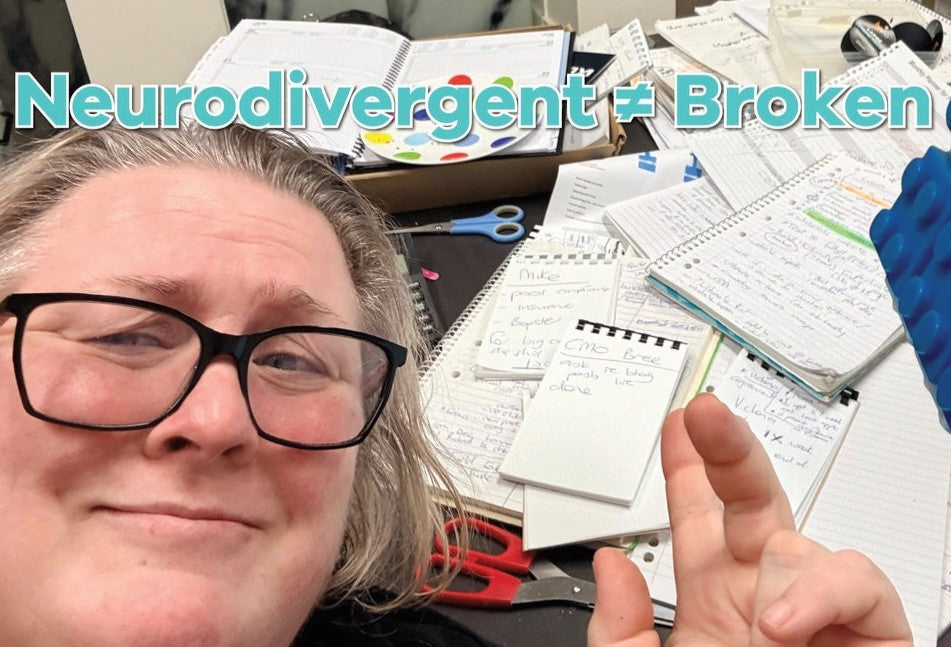
Neurodivergent ≠ Broken
ADHD is a bit like trying to solve a Rubik’s Cube (and “try harder” is not the solution)
If you are ADHD (or you’re neurodivergent in any flavour), you’ve probably heard some version of:
“Just focus.”
“Just be more disciplined.”
“It’s not that hard.”
And honestly… respectfully… F off! (eek ...did i jsut type that lol)
Because working with an ADHD brain is a bit like solving a Rubik’s Cube.
It’s not simple.
It’s not linear.
And it’s definitely not something you solve by forcing it.
You’re not lazy
You’re dealing with a complex system.
This is the part I wish more people understood.
ADHD isn’t “not trying hard enough.”
It’s living inside a brain that’s running a very complex operating system — where everything affects everything.
You fix one side… and another side breaks.
You finally get productive and smash through a task? Amazing.
But then suddenly:
- you forgot to eat
- you forgot to drink water
- you didn’t notice you were overstimulated
- you didn’t go to bed
- your sleep crashes
- your nervous system crashes
- and then your whole week crashes
And then you’re sitting there thinking:
“Why can’t I just function like a normal person?” It’s not because you’re broken.
It’s because you’re running a system that doesn’t respond to brute force.
You don’t solve a Rubik’s Cube by forcing it.
You solve it by understanding how it works.
You learn the patterns.
You learn the algorithms.
You learn what happens when you move one piece, because you know it affects everything else.
And ADHD is the same.
You don’t “fix” an ADHD brain by trying harder.
You support it by understanding the system.
It’s not discipline. It’s dopamine.
This is one of the biggest mindset shifts that changed my life:
ADHD brains don’t run on discipline.
They run on dopamine, novelty, interest, urgency, and connection.
So if you keep trying to force yourself through life using neurotypical strategies (routine, willpower, consistency)… you’re basically trying to run Android apps on an iPhone.
Not broken.
Just… different operating systems.
Different operating systems doesn’t mean one is “better”
This is how I explain ADHD to people:
There are Apple phones and there are Android phones.
One isn’t better than the other… although yes, some people will absolutely argue about it like it’s a religion.
But they are different.
They behave differently.
They respond differently.
They need different systems.
And honestly? Brains are the same.
Some people have blue eyes.
Some people have green eyes.
And some people have neurotypical brains… and some people have neurodivergent brains.
Different wiring. Different operating system.
So what do you DO with that?
This is where I shift into my O.T. brain:
We strip tasks down.
We break activities into pieces.
We make things achievable.
Because the ADHD brain doesn’t cope well with the “whole cube.”
It copes with one move at a time.
1. Break it down into bite-sized pieces (seriously… tiny)
For me, this is the biggest one.
When I look at my house and I see doom piles, a kitchen bench that looks like a tornado hit it, dishes everywhere, laundry mountains, and 47 unfinished projects…
My brain doesn’t go: “Let’s calmly work through this.”
My brain goes: “This is too much. I am failing at life. Burn the house down.”
So instead of telling myself I have to do everything, I give myself permission to do one tiny piece.
Not “clean the kitchen.” More like:
- Put the cups in the dishwasher or - Clear the kitchen table for 3 minutes
Because once I start, the system starts moving.
And sometimes I stop after 3 minutes and that’s fine.
Because 3 minutes is still progress.
And progress is the goal, not perfection.
2. Use novelty (because your brain is basically a dopamine-seeking missile)
Sometimes the task that needs doing is the one that has been staring me in the face for days.
And my brain hates it now.
It has become The Task Of Doom™.
So I don’t start with that task.
I start with a different task — something slightly more interesting, more novel, more satisfying.
Because the goal isn’t “do the most important thing first.”
The goal is: Get dopamine into the system so the engine turns on.
Once my brain is engaged, I can often swing back around and tackle the harder thing.
It’s like warming up the car before you try to drive it.
3. Reward-based motivation is not childish. It’s strategic.
Sometimes I will absolutely bribe myself.
And I used to feel bad about that. But now I’m like… why?
If my brain responds to reward and anticipation, then I’m just working with my system.
So yes, I might say:
“After I do X, I get my ice cream.”
Or:
“After I do this, I can sit down use a pick ‘em pad.”
That’s not weak.
That’s not lazy.
That’s literally understanding (my) algorithm.
Angie (one of my incredible team and deliciously referred to as Jo’s ‘Coordinator of chaos’ gave me a gift of this in ACTION… a small cube timer that when flipped automatically starts a timer – each side with different time amounts … Choose your own adventure for timer length. SOOOOO much dopamine & practical support in this tiny tool!
4. Transitions are HARD. So build a dopamine bridge.
This is a personal one.
I struggle massively with transitions.
Getting out of bed.
Getting into the shower.
Switching tasks.
Starting the ‘thing’.
Sometimes it feels like my brain is physically stuck.
So one thing that works for me is having something I’m excited about on the other side of the transition.
For example: If I want to get into the shower but I’m frozen, I’ll tell myself: “After the shower, I get my favourite breakfast.” And that anticipation helps me skip over the overwhelm.
5. Learn the signs of overwhelm… and give yourself permission to STOP.
ADHD brains often don’t notice we’re overwhelmed until we’re already past the point of no return.
And then we do the classic spiral:
Get overloaded.
Push through anyway.
Melt down.
Crash.
Beat ourselves up for crashing.
So now I try to notice earlier signs — irritability, zoning out, sensory overwhelm, brain fog, emotional reactivity.
And when I see those signs, I try to step away.
Not because I’m failing.
But because I’m listening to my system.
6. Body doubling is actual magic
Body doubling is one of the best ADHD strategies out there.
You don’t do the task alone.
You do it with someone nearby.
Not necessarily helping you… just existing alongside you.
Because ADHD brains respond to connection, presence, and momentum.
I call this my ‘Jaytee effect’ (aka: how my gorgeous team member hacks my brain lovingly). Jaytee has figured me out completely. Aside from gifting me the best drink bottle ever she also knows how to assist me to START tasks im struggling with. 
Image of a hilarious and accurate custom water bottle saying "Drink some water Joanne or you with f!#@ing die! "
If I’m overwhelmed, she doesn’t say: “Jo, you need to do this.” Because that triggers PDA... and my nervous system immediately goes: HARD NO!
Instead, she just starts doing a tiny part of it.
And then my brain sees it and goes:
“Oh… that looks doable.”
“Oh… that looks fun.”
And suddenly I’m doing it with her.
Not because she forced me.
But because she created a doorway into the task that didn’t trigger resistance.
That is real support.
I guess the point is: you don’t need to fight your brain.
ADHD can be incredibly challenging.
It can feel exhausting.
It can feel like you’re failing at things that other people seem to do effortlessly.
And it’s easy to feel broken.
But you’re not broken.
You’re running a different operating system.
And once you understand your patterns — once you learn what helps and what crashes the system — you If Just a gentle encouragement to be kinder to yourself and not force yourself into a ‘neurotypical mould’.
That way you can journey toward building a safe space/world that actually works for your wiring.
Final take-home: Solve one side at a time
If your life feels like a Rubik’s cube right now, I hope this is a little reminder that:
You don’t have to solve the whole cube today.
Just pick one side.
One small move.
One tiny step.
And if you 'fix' one piece and something else slips? That doesn’t mean you failed.
It means you’re learning the system. And that is progress & more than ok!
And if you are a 70’s or 80’s kid like me lol … you know the ultimate workaround hack: peel the stickers off! … & ‘solve’ it a different way lol.
Love Jo
Some additional ADHD Glitter Nuggets I’ve gleaned over the years (Expert-Backed Sprinkles of Wisdom)
These are simple, practical ADHD-friendly strategies that come up again and again across ADHD experts, coaches, and lived-experience communities. They’re not about fixing you — they’re about supporting your system. Ultimately… trust your gut.. (some below may not be ‘true’ for you) … and be kind to yourself!
· 🕰️ Make time visible: timers + alarms help with time blindness
· 🍅 Try Pomodoro blocks (e.g. 10–25 mins focus + short breaks) to build momentum
· 📌 Break tasks into *ridiculously small* steps (make the first step almost too easy)
· ⏱️ Add buffer time between tasks (transitions take longer than your brain predicts)
· 🚫 Reduce distractions in your environment (notifications off, visual clutter down)
· 🎧 Use sound strategically (noise-cancelling, white noise, or a consistent focus playlist)
· 👣 Create a ‘start cue’ ritual (shoes on, playlist on, desk cleared = brain gets the signal)
· 📅 Externalise memory: calendars, reminders, notes, checklists (your brain is not a storage device)
· 🧠 Work with dopamine: novelty, urgency, interest, and reward are valid tools
· 🔄 Build micro-routines (5 minutes a day beats ‘all-or-nothing’ perfection)
· 🌿 Mindfulness / breath resets can help interrupt spirals and emotional overwhelm
· 🌤️ Take planned breaks before your brain forces a crash
· (use image of a cog as an icon) Have sensory supports on hand/on person to assist with motivation/focus/regulation in the ‘moment’
· 🤝 Body doubling is not cheating — it’s a legitimate strategy
· 💡 Remember: ADHD also comes with strengths (intuition, creativity, fast problem-solving, deep passion)
Kaiko translation: it’s not about trying harder. It’s about building a system that actually works for your wiring.
